Kitchen Layout Guide
Parallel Kitchens: The Most Efficient Layout for Serious Cooking Spaces
Two counters. One clear movement path. Maximum efficiency.
The parallel kitchen is one of the most functionally efficient layouts in residential design. Two counters run parallel to each other on opposite walls, creating a clear working corridor between them. Everything the cook needs — prep, cooking, washing, storage, and appliances — is within a few short steps, facing the same direction or easily accessible across the corridor.
In Indian cooking, where the routine often involves multiple simultaneous processes — one pot on the flame, one dish being prepped, water on to boil, masala being ground — the parallel kitchen is quietly one of the most practical layouts available. It keeps things reachable without the cook needing to travel far, turn repeatedly, or compete for counter space.
The parallel kitchen is also underappreciated aesthetically. When planned with premium materials, thoughtful lighting, and good storage organisation, a parallel kitchen can look every bit as refined as a more complex layout. The discipline of the two-counter form supports a clean, architectural visual quality that suits many modern Indian homes.
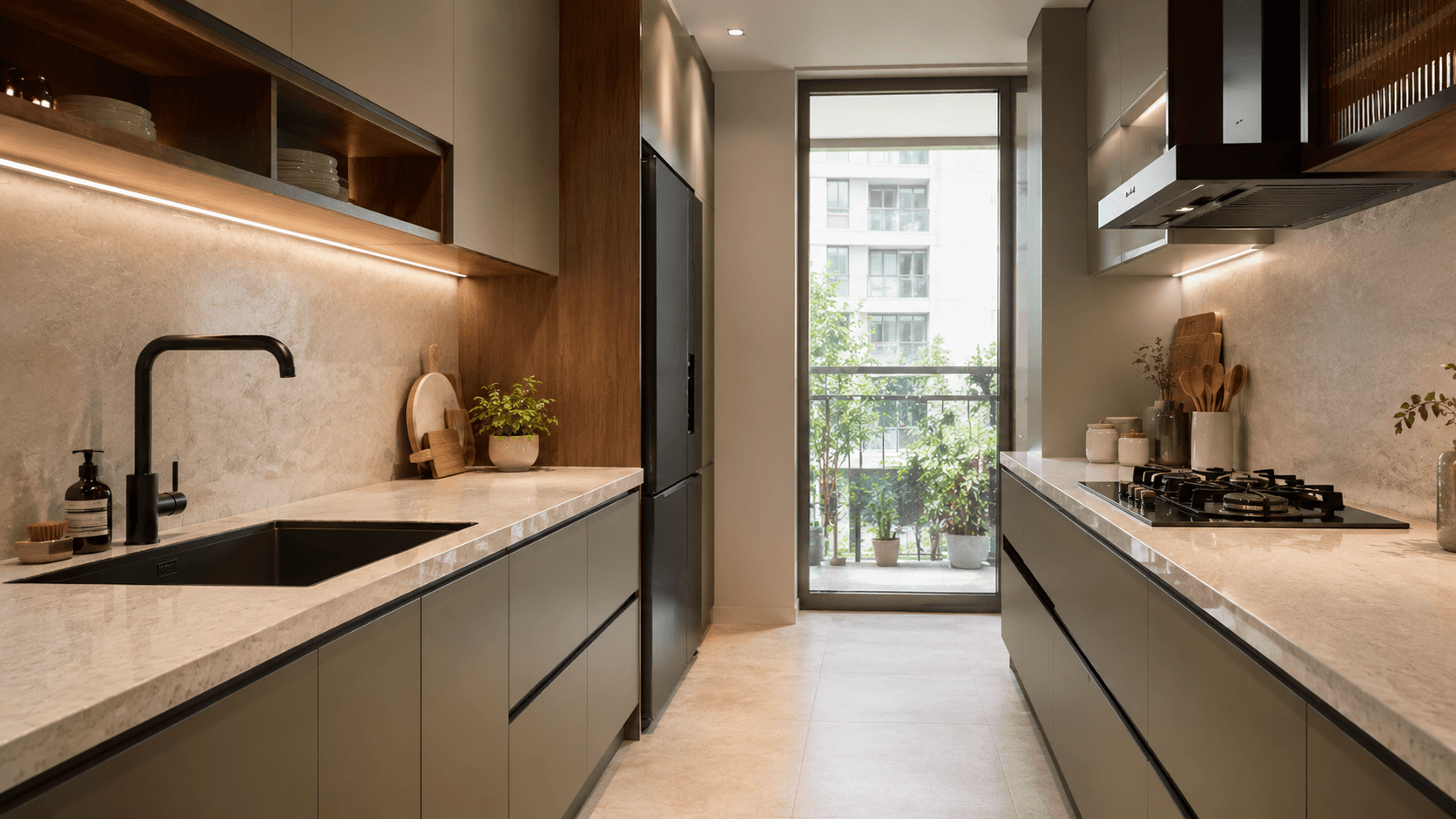
Visual reference for a typical Parallel Kitchen configuration. Exact design is customised to your room dimensions.
At a Glance
Quick verdict: is the parallel kitchen right for your home?
Suitability
When does this layout work —
and when should you reconsider?
Apartments with a designated enclosed kitchen room
The parallel layout is extremely well-suited to the standard Indian apartment kitchen plan — a separate, enclosed kitchen room with two facing walls and a door at one or both ends. Both walls are used fully, and the corridor between them becomes a clear, efficient working space.
Homes with a dedicated cook or heavy cooking habits
If the primary use of the kitchen is serious, sustained cooking — daily Indian meals with multiple dishes, regular entertaining through the kitchen, or a household cook who uses the space professionally — the parallel layout is one of the most productive available.
Narrow or rectangular rooms
Rectangular kitchens with two long parallel walls are ideally suited for this layout. The room shape and the layout align naturally, making efficient use of every centimetre of both walls.
Families with significant storage requirements
Two full counter runs mean two full walls of upper and lower cabinet storage. For households with significant cookware, appliances, groceries, and daily-use items, this layout provides one of the highest storage densities available.
Homes where the kitchen is a private working space
If the kitchen is a separate working room rather than a social performance space, the parallel layout prioritises function beautifully. It is efficient, organised, and easy to manage daily.
Joint families and large households
The storage capacity and cooking efficiency make parallel kitchens effective in homes where multiple dishes are prepared simultaneously and the kitchen sees heavy daily use.
Work Triangle
How the stove, sink, and fridge
connect in this layout.
The work triangle is the movement route between your cooking zone, washing zone, and cold storage zone — hob, sink, and refrigerator. In a parallel kitchen, this triangle is one of the easiest to achieve efficiently because both counters are directly accessible and the movement between zones is short and direct.
Hob
Typically on the counter closer to the exterior wall for chimney ducting convenience, or the counter most comfortable for the main cook
Which counter carries the hob depends on the window position, chimney duct path, and plumbing outlet location — all confirmed on site.
Sink
On the opposite counter from the hob, or on the same counter with a comfortable working gap from the hob
Having the sink across from the hob creates a natural pattern — prep near the sink, cooking at the hob, with a one-step cross-corridor movement between the two.
Fridge
At one end of a counter run — ideally at the entry end of the kitchen
Placing the fridge at the entry end keeps it accessible without requiring family members to enter the full cooking zone, which is particularly useful in busy households.
Movement Pattern
In a well-planned parallel kitchen, the triangle movement is almost entirely linear or a single-step cross-corridor movement. There is no island to walk around, no corner to navigate. Hob is close, sink is across or beside, fridge is at the end. This makes the parallel kitchen one of the fastest-working layouts in real use.
How ARITSAN approaches this
The precise placement of hob, sink, and fridge in a parallel kitchen depends on where your plumbing outlet is, which wall the chimney needs to duct through, and which counter orientation feels most natural for your primary cook. ARITSAN maps all of these on site before confirming the layout.
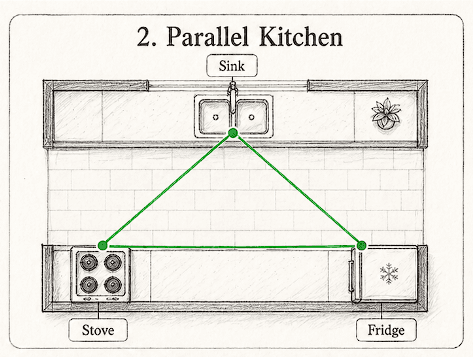
Work triangle zones:
Diagram is illustrative. Exact zone placement depends on your room dimensions, plumbing outlet, chimney duct path, and appliance sizes. ARITSAN maps this on site.
Planning Guide
Key specifications
to plan before you commit.
All specifications are directional. Exact dimensions depend on wall lengths, door positions, plumbing locations, chimney duct path, and appliance sizes. ARITSAN confirms all specifications on site.
Honest Assessment
What works well —
and what needs careful planning.
Why a Parallel Kitchen Works
- One of the most efficient work triangles available in kitchen design
- Both walls provide full upper and lower cabinet storage — excellent storage density
- Clean, architectural visual quality when planned and finished well
- Works extremely well for Indian cooking — multiple simultaneous processes within reach
- Straightforward service planning — plumbing and electrical on fixed walls, chimney on one wall
- Relatively lower planning complexity compared to island kitchens
Things to Plan Carefully
- Corridor width is the critical variable — too narrow creates daily frustration
- Not suited to open-plan homes or kitchens intended to feel socially connected
- Two people in the kitchen simultaneously requires corridor management
- End access and ventilation must be checked, especially in fully enclosed rooms
- Can feel monotonous if finishes, lighting, and materials are not varied thoughtfully between the two sides
- Storage organisation requires deliberate planning — everything behind cabinet doors on two sides
Lifestyle Fit
Who should choose
the parallel kitchen?
Serious home cooks
The parallel kitchen is built for efficiency. Everything is close, the triangle is short, and the workflow is uninterrupted — ideal for daily, multi-dish cooking.
Households with a dedicated cook
When someone cooks professionally in the home, the parallel kitchen gives them a workspace that functions like a proper professional kitchen without unnecessary complexity.
Compact apartment living
Two full counter runs in a well-proportioned corridor give a smaller kitchen more storage and working surface than many other layouts can offer in the same footprint.
Families with heavy storage needs
Joint families, large households, and homes with significant cookware, groceries, and appliances benefit from the maximum cabinet storage a parallel kitchen provides.
Less suited for
- Homes where the kitchen is a social or visual centrepiece
- Open-plan spaces where the kitchen connects to living and dining areas
- Compact rooms where the corridor cannot achieve a comfortable working width
Planning Pitfalls
Common planning mistakes
to avoid with this layout.
Designer's Note
The parallel kitchen is often underestimated because it does not make a dramatic visual statement the way an island does. But in daily use, a well-planned parallel kitchen is one of the most satisfying kitchens to cook in. Everything is close. The workflow is clear. There is no unnecessary movement. When the materials, finishes, and lighting are planned well, a parallel kitchen can look just as refined as any other layout — and feel far more efficient.
— ARITSAN Design Team
ARITSAN's Recommendation
When would ARITSAN recommend
this layout for your home?
ARITSAN would recommend a parallel kitchen for any enclosed or semi-enclosed kitchen room where cooking efficiency, storage capacity, and daily functional comfort are the primary goals. It is particularly well-suited to Indian apartment plans where the kitchen is a dedicated working room with two facing walls.
When the corridor width is not workable — or when the client's priority is an open, social kitchen connected to the living or dining area — we would explore an L-shaped or island layout instead.
The parallel kitchen is not a compromise. When the space supports it, it is one of the most intelligent and satisfying kitchen layouts available.
Layout Comparison
Which layout wins
for which need?
Best for compact homes
L-Shaped or Parallel
Uses two walls efficiently with minimal footprint.
Best for heavy Indian cooking
Parallel or U-Shaped
Short work triangle, maximum counter proximity, high storage.
Best for open-plan social kitchens
Island or L-Shaped
Connects naturally to living and dining areas.
Best for maximum storage
U-Shaped
Three full walls of upper and lower cabinet storage.
Best for hosting guests
Island Kitchen
Island becomes the social anchor — prep, serve, converse.
Best for enclosed apartment kitchens
Parallel or U-Shaped
Works best in dedicated, closed kitchen rooms.
Kitchen Fit Quiz
Which kitchen layout
may suit your home?
Answer six quick questions. This is an indicative guide — a site measurement always gives the clearest answer.
01.Is your kitchen open to the living or dining area?
02.Is there enough room for comfortable movement in the centre of your kitchen?
03.Do you cook seriously every day — multiple dishes simultaneously?
04.Do you host guests often and want the kitchen to be part of that experience?
05.Is maximum storage your top priority?
06.Is your kitchen in a compact apartment or a larger independent home?
Common Questions
Questions about
the parallel kitchen.
Send us your kitchen room dimensions
Not sure if the parallel kitchen fits your home?
- ARITSAN helps compare layout options based on your actual room dimensions.
- We coordinate design, sourcing, and execution through verified partners.
- You understand the plan before committing to any investment.