Kitchen Layout Guide
The L-Shaped Kitchen: Where Openness and Practicality Meet
The most versatile layout for Indian homes — and the most widely adaptable.
The L-shaped kitchen is the most commonly used layout in Indian residential interiors — and for good reason. Two connected counter runs placed along two adjacent walls meeting at a corner create an open working space that balances cooking efficiency with room-use flexibility.
Unlike the parallel kitchen, the L-shaped layout does not require a dedicated corridor room. It can sit within a larger open room, connect naturally to a dining area, and still keep all the kitchen functions accessible within a compact footprint. Unlike an island kitchen, it does not require significant clearance on multiple sides or complex plumbing and electrical extensions to the centre of the room.
What makes an L-shaped kitchen excellent is not just the shape — it is how well the corner is used, how cleanly the work triangle is planned, and whether the two counter runs are proportioned in a way that gives each zone enough working room.
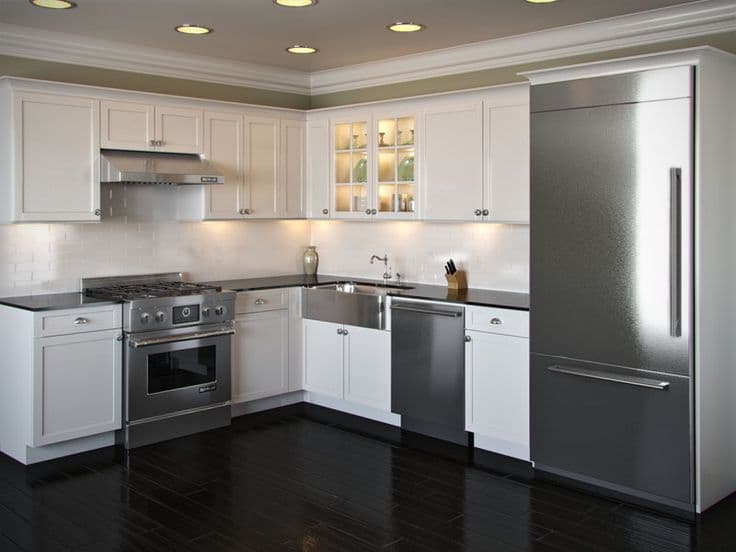
Visual reference for a typical L-Shaped Kitchen configuration. Exact design is customised to your room dimensions.
At a Glance
Quick verdict: is the l-shaped kitchen right for your home?
Suitability
When does this layout work —
and when should you reconsider?
Apartments with a corner kitchen zone
Many Indian apartment plans have the kitchen occupying a corner zone — with two walls available and the rest of the floor plan opening into the living or dining area. The L-shaped kitchen is the natural answer for this plan type.
Homes wanting a breakfast counter or dining connection
One arm of the L can extend into a breakfast counter — raising the counter height on the outer edge and adding bar stools on the living or dining side. This creates a natural transition between the kitchen and the adjacent room without requiring a central island.
Small to medium kitchens
The L-shaped layout is highly space-efficient. It keeps all three zones of the work triangle on two adjacent walls, leaving the rest of the floor plan open for movement and other uses.
Semi-open kitchens
When the kitchen is not entirely enclosed but not fully open either — perhaps a half-wall or pass-through connects it to the dining area — the L-shaped layout works beautifully. One arm faces the kitchen interior, the other can face outward.
Homes where one person primarily cooks
The open arc-shaped movement pattern of an L-kitchen is comfortable for one cook moving between the three zones. The layout is efficient without being tight.
First-time homeowners and new setups
The L-shaped kitchen is forgiving to plan, straightforward to execute, and adaptable to a range of budgets and finish levels. It is an excellent starting point for most residential kitchen conversations.
Work Triangle
How the stove, sink, and fridge
connect in this layout.
The L-shaped kitchen creates one of the most natural work triangles in residential design. The two arms of the L give the cook a corner anchor, and the triangle typically distributes across the two arms in a way that feels intuitive and low-effort.
Hob
Usually on the longer arm of the L — away from the corner, with enough counter space on either side for landing, prep, and cooking
This placement allows the chimney to be wall-mounted above it comfortably. Exact position depends on chimney duct path and cooking orientation preference.
Sink
On the other arm of the L — or on the same arm with a comfortable gap from the hob
When the sink is on the perpendicular arm, the movement between washing and cooking becomes a short, natural pivot at the corner — one of the most efficient sink-hob relationships available in residential kitchen design.
Fridge
At the end of one arm — ideally close to the kitchen entrance
Accessible without entering the main cooking zone, which is useful when family members frequently access the fridge independently of the cook.
Movement Pattern
In an L-shaped kitchen, the triangle movement is a smooth arc — the cook pivots from the sink arm to the hob arm, with the fridge a few steps away at the end of one run. There is no corridor to cross, no island to walk around. The movement is fluid and low-effort in daily use.
How ARITSAN approaches this
The corner of the L is the most important storage area to plan carefully. It can become wasted or hard-to-reach space if not fitted with appropriate corner solutions — carousel units, pull-out corner drawers, or swing-out storage. ARITSAN assesses the corner configuration on site before confirming the layout.
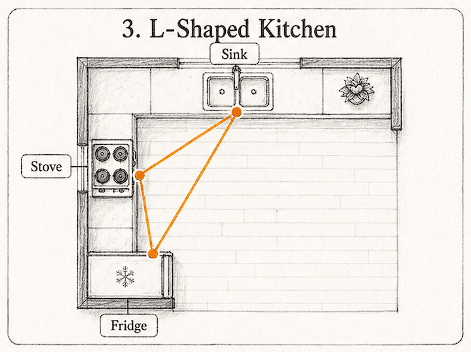
Work triangle zones:
Diagram is illustrative. Exact zone placement depends on your room dimensions, plumbing outlet, chimney duct path, and appliance sizes. ARITSAN maps this on site.
Planning Guide
Key specifications
to plan before you commit.
All specifications are directional. Exact dimensions depend on wall lengths, corner configuration, door and window positions, plumbing locations, and appliance sizes. ARITSAN confirms all specifications on site.
Honest Assessment
What works well —
and what needs careful planning.
Why an L-Shaped Kitchen Works
- Natural, intuitive work triangle with smooth arc movement — one of the most comfortable in residential design
- Leaves the rest of the room open — excellent for semi-open or open-plan living
- Adaptable to a wide range of room sizes and shapes
- Can incorporate a breakfast counter or dining connection without major complexity
- Relatively straightforward to plan and execute
- Corner can become excellent storage when planned with the right solution
Things to Plan Carefully
- Corner storage requires deliberate planning — can easily become wasted space without the right solution
- Upper cabinets meeting at the corner need careful visual and functional detailing
- One arm may end up shorter than ideal if room dimensions are limited
- May not provide enough storage for households with very heavy storage needs — consider a U-shaped layout
- Multiple simultaneous cooks can feel crowded in the movement arc
- Does not provide the storage density of a U-shaped kitchen or the corridor efficiency of a parallel kitchen
Lifestyle Fit
Who should choose
the l-shaped kitchen?
Apartment living
The L-shaped kitchen is the default ideal for most Indian apartments. It uses a corner efficiently, leaves the room open, and can connect to the dining area if the plan supports it.
Semi-open kitchens
When the homeowner wants a kitchen that feels part of the home without being fully open, the L-shaped layout allows one arm to face the living or dining area — creating connection without completely exposing the cooking zone.
Compact homes
The L-shaped kitchen delivers a good work triangle and reasonable storage in a relatively small footprint — one of the most space-efficient options for smaller homes.
Homeowners who primarily cook alone
The arc movement of the L-shaped kitchen is comfortable and efficient for one person moving between the three zones — hob, sink, and fridge — without any unnecessary steps.
Less suited for
- Rooms with no adjacent corner walls
- Households needing maximum three-wall storage capacity
- Homes where heavy simultaneous cooking by multiple people is the norm
Planning Pitfalls
Common planning mistakes
to avoid with this layout.
Designer's Note
The L-shaped kitchen's strength is its adaptability — it is the layout that almost always finds a way to work in the space available. But adaptability should not be mistaken for simplicity. The corner is where most L-shaped kitchens lose their quality. Plan the corner storage, the corner lighting, and the corner visual treatment well, and the kitchen moves from functional to genuinely well-designed.
— ARITSAN Design Team
ARITSAN's Recommendation
When would ARITSAN recommend
this layout for your home?
ARITSAN would recommend an L-shaped kitchen for most Indian apartments and medium-sized homes, particularly when the kitchen is semi-open or connects to a dining area, when one person primarily cooks, and when the room configuration naturally offers two adjacent working walls.
When the client needs maximum storage across three walls, we would assess whether a U-shaped layout is more appropriate. When the client wants a stronger open-plan social kitchen, we would assess whether an island option is feasible.
The L-shaped kitchen is a strong, versatile starting point for almost every kitchen design conversation — and for many homes, it is the final answer.
Layout Comparison
Which layout wins
for which need?
Best for compact homes
L-Shaped or Parallel
Uses two walls efficiently with minimal footprint.
Best for heavy Indian cooking
Parallel or U-Shaped
Short work triangle, maximum counter proximity, high storage.
Best for open-plan social kitchens
Island or L-Shaped
Connects naturally to living and dining areas.
Best for maximum storage
U-Shaped
Three full walls of upper and lower cabinet storage.
Best for hosting guests
Island Kitchen
Island becomes the social anchor — prep, serve, converse.
Best for enclosed apartment kitchens
Parallel or U-Shaped
Works best in dedicated, closed kitchen rooms.
Kitchen Fit Quiz
Which kitchen layout
may suit your home?
Answer six quick questions. This is an indicative guide — a site measurement always gives the clearest answer.
01.Is your kitchen open to the living or dining area?
02.Is there enough room for comfortable movement in the centre of your kitchen?
03.Do you cook seriously every day — multiple dishes simultaneously?
04.Do you host guests often and want the kitchen to be part of that experience?
05.Is maximum storage your top priority?
06.Is your kitchen in a compact apartment or a larger independent home?
Common Questions
Questions about
the l-shaped kitchen.
Tell us about your kitchen space
Not sure if the l-shaped kitchen fits your home?
- ARITSAN helps compare layout options based on your actual room dimensions.
- We coordinate design, sourcing, and execution through verified partners.
- You understand the plan before committing to any investment.