Kitchen Layout Guide
Is an Island Kitchen Right for Your Home?
The layout that changes how a home feels — but only when planned properly.
An island kitchen is one of the most aspirational layouts in modern Indian homes. The moment a kitchen opens up with a central island, the room feels different — more generous, more social, more considered. It stops being just a cooking room and starts feeling like the heart of the home.
But the island is also one of the most misunderstood layouts in Indian residential planning. In a showroom, every island looks inviting. In a real home, the island is only as good as the space around it. Movement, ventilation, plumbing, clearance, and daily cooking habits all determine whether an island kitchen is a pleasure to use or a beautiful inconvenience.
At ARITSAN, we start the island conversation with one question: does the space allow an island to breathe — or will it turn a generously sized kitchen into a movement puzzle? That answer shapes everything that follows.
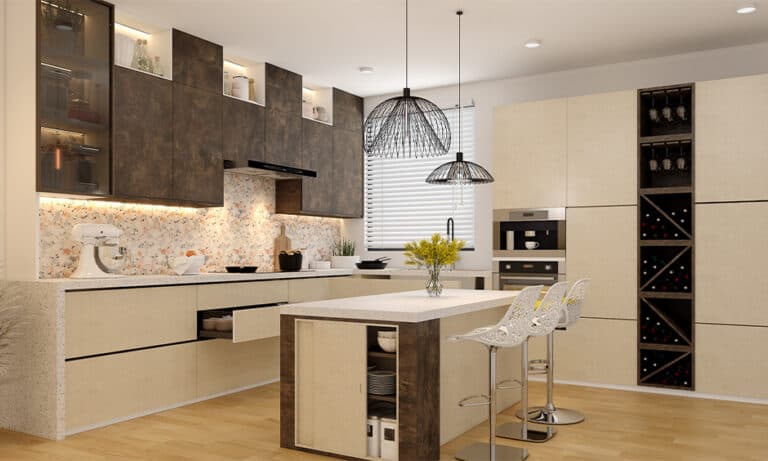
Visual reference for a typical Island Kitchen configuration. Exact design is customised to your room dimensions.
At a Glance
Quick verdict: is the island kitchen right for your home?
Suitability
When does this layout work —
and when should you reconsider?
Open-plan living
Island kitchens thrive where the kitchen connects to the dining or living area. The island becomes the social anchor — where guests gather, children do homework while parents cook, and morning conversations happen without anyone feeling isolated.
Larger apartments and villas
Homes above a certain square footage — 2BHK and 3BHK apartments with larger kitchen zones, and independent villas — are the right candidates. The room must allow comfortable clearance on every open side of the island.
Families that cook together or host regularly
The island supports more than one person in the kitchen simultaneously. One person preps on the island while another cooks at the wall counter. The island also creates a natural service zone for plating and passing food across to the dining side.
Design-conscious homeowners
When the overall home is open, layered, and contemporary, an island kitchen can anchor the entire public space visually and functionally. The aesthetic and lifestyle case for it is strongest here.
Rooms with a generous footprint
Rectangular rooms with clear wall runs tend to support island placement most predictably. Irregular-shaped rooms require more careful planning to achieve comfortable clearance on all island sides.
Work Triangle
How the stove, sink, and fridge
connect in this layout.
The work triangle is the three-point movement route between where you cook, where you wash, and where you access cold storage — the hob, the sink, and the refrigerator. A well-planned work triangle makes daily cooking feel natural and low-effort. A poorly planned one means constant crossing, backtracking, and friction.
Hob
Island or wall counter, depending on ventilation and preference
When the hob is on the island, cooking becomes more social — the cook faces the dining area. When the hob is on the wall counter, the island becomes the primary prep and serving zone.
Sink
Island or wall counter, depending on floor plumbing feasibility
An island sink is practical for prep washing and creates a natural flow from washing to chopping to serving. Requires floor-level plumbing planning confirmed at site stage.
Fridge
Wall side — typically at one end of the main counter or in a tall unit zone
Placing the fridge on the wall keeps it accessible from both the kitchen and the dining area without requiring a trip around the island.
Movement Pattern
In an ideal island kitchen, the triangle should allow easy movement without forcing the cook to walk around the island to reach any of the three zones. The island should sit between the prep zone and the serving zone — not between the cooking zone and the washing zone in a way that creates constant detours.
How ARITSAN approaches this
ARITSAN maps the work triangle against your actual wall lengths, door positions, window positions, plumbing line locations, and cooking habits before finalising any layout. The triangle on paper and the triangle in real use can feel very different — site reality always takes precedence over concept diagrams.
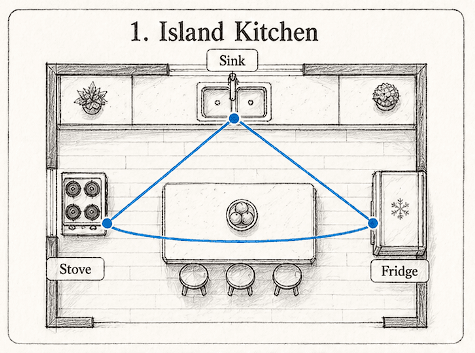
Work triangle zones:
Diagram is illustrative. Exact zone placement depends on your room dimensions, plumbing outlet, chimney duct path, and appliance sizes. ARITSAN maps this on site.
Planning Guide
Key specifications
to plan before you commit.
All specifications below are directional principles. Exact dimensions depend on your room size, wall configuration, door and window positions, plumbing outlet locations, chimney ducting path, and appliance sizes. ARITSAN confirms all specifications on site before layout finalisation.
Honest Assessment
What works well —
and what needs careful planning.
Why an Island Kitchen Works
- Creates a natural social and visual anchor in open-plan homes
- Allows more than one person to work in the kitchen simultaneously without crossing paths
- Adds significant prep and serving surface area
- Island base adds storage through drawers or seating space
- Connects the kitchen to dining and living in a way other layouts cannot match
- Supports modern lifestyle needs — breakfast bars, serving stations, social cooking
Things to Plan Carefully
- Requires adequate clearance on all open sides — compromised movement ruins the benefit
- Plumbing and electrical to the island require early coordination with civil and MEP teams
- Island chimney installation is more complex and typically more expensive than a wall chimney
- Not ideal in a fully enclosed kitchen room with no connection to living or dining
- Total cost is typically higher — more linear footage, plumbing, electrical, and chimney
- Cleaning under and around the island needs to be accounted for in the design from the start
Lifestyle Fit
Who should choose
the island kitchen?
Families who cook together
The island supports multiple cooks naturally — one at the wall counter, one at the island, without constant crossing or competing for space.
Hosts and entertainers
The island becomes the social surface — guests gather here, drinks are served here, conversations flow while food is being plated.
Design-conscious homeowners
The island is the centrepiece of a modern home's most visible room. When planned well, it elevates the entire floor visually.
Homes with house help or a dedicated cook
The island creates a natural division — the cook uses the main counter and hob, while the homeowner interacts on the island side without entering the primary cooking zone.
Less suited for
- Compact apartments where movement clearance cannot be maintained
- Enclosed kitchens with no connection to a living or dining area
- Households where cooking is minimal and storage is the dominant priority
Planning Pitfalls
Common planning mistakes
to avoid with this layout.
Designer's Note
An island kitchen should not be selected only because it looks luxurious. The real luxury is comfort — enough space to move around it, prep on it, serve from it, and cook near it without the kitchen ever feeling crowded. When the space allows it, an island kitchen genuinely changes how a home functions and feels. When it does not, it can become the most expensive inconvenience in the house.
— ARITSAN Design Team
ARITSAN's Recommendation
When would ARITSAN recommend
this layout for your home?
ARITSAN would recommend an island kitchen when the room dimensions clearly support comfortable movement on all sides of the island, the kitchen connects to an open dining or living area, and the household lifestyle includes regular hosting, cooking together, or a desire for a social kitchen experience.
When the space is smaller, the kitchen is enclosed, or the budget does not accommodate the full planning complexity of an island, we would explore an L-shaped or parallel layout instead — which can be equally premium in finish and significantly more practical in daily use.
A site measurement is always the first step. The island decision should follow the measurement, not precede it.
Layout Comparison
Which layout wins
for which need?
Best for compact homes
L-Shaped or Parallel
Uses two walls efficiently with minimal footprint.
Best for heavy Indian cooking
Parallel or U-Shaped
Short work triangle, maximum counter proximity, high storage.
Best for open-plan social kitchens
Island or L-Shaped
Connects naturally to living and dining areas.
Best for maximum storage
U-Shaped
Three full walls of upper and lower cabinet storage.
Best for hosting guests
Island Kitchen
Island becomes the social anchor — prep, serve, converse.
Best for enclosed apartment kitchens
Parallel or U-Shaped
Works best in dedicated, closed kitchen rooms.
Kitchen Fit Quiz
Which kitchen layout
may suit your home?
Answer six quick questions. This is an indicative guide — a site measurement always gives the clearest answer.
01.Is your kitchen open to the living or dining area?
02.Is there enough room for comfortable movement in the centre of your kitchen?
03.Do you cook seriously every day — multiple dishes simultaneously?
04.Do you host guests often and want the kitchen to be part of that experience?
05.Is maximum storage your top priority?
06.Is your kitchen in a compact apartment or a larger independent home?
Common Questions
Questions about
the island kitchen.
Share your kitchen dimensions with ARITSAN
Not sure if the island kitchen fits your home?
- ARITSAN helps compare layout options based on your actual room dimensions.
- We coordinate design, sourcing, and execution through verified partners.
- You understand the plan before committing to any investment.