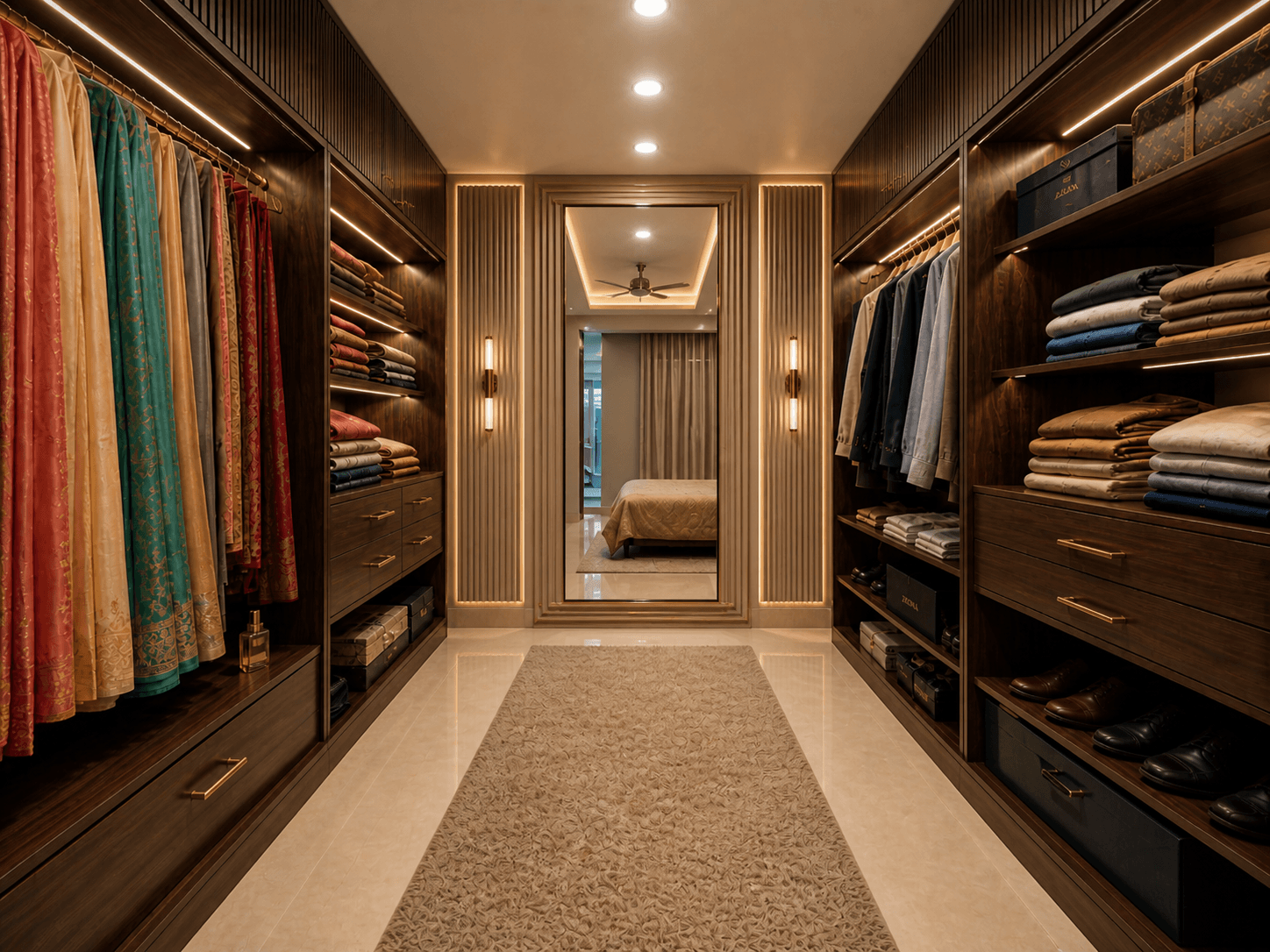
There is a moment most homeowners recognise. You open your wardrobe — crammed, folded awkwardly, sarees pressed against blazers, shoes hiding behind stacked bedsheets — and think: there has to be a better way.
There is. A walk-in wardrobe turns a wall of frustration into a private room where every garment has a place, every accessory is visible, and getting dressed in the morning stops being a scavenger hunt. It is part storage, part dressing room, part daily ritual.
But here is what most design blogs will not tell you honestly: a walk-in is not right for every home. It depends on your bedroom size, your clothing inventory, your climate, and your budget. This guide helps you figure out whether a walk-in makes sense for your home — and if it does, how to plan one that actually works for Indian life.
What Actually Makes a Walk-in Different?
A walk-in wardrobe is not just a larger cupboard. The defining feature is that you step inside the storage space. You are surrounded by your clothes, shoes, and accessories — everything visible, everything accessible.
Compare that to a standard hinged or sliding wardrobe, where you stand outside and reach in, seeing only what is directly in front of you.
What a walk-in gives you that a regular wardrobe cannot:
- Full visibility — You see your entire collection at a glance. No more forgetting clothes buried at the back.
- Dedicated zones — Separate sections for hanging, folding, accessories, shoes, and seasonal storage.
- A dressing room experience — Space for a mirror, a stool, a vanity. Getting ready becomes calm instead of chaotic.
- Bedroom clarity — All visual clutter moves behind a door or partition. Your bedroom stays minimal and restful.
At ARITSAN, we describe it as your private dressing room — space to move, plan outfits, and store everything in a calm, organised way.
Can Your Home Support One? An Honest Assessment
This is where most articles lose credibility. They show you stunning walk-in photos and leave you to figure out that your 10 x 12 ft bedroom cannot actually accommodate one. Let us be direct.
Minimum space required
- Absolute minimum: 4 ft × 4 ft (functional, but cramped — single-wall storage only, limited walking room)
- Practical minimum: 6 ft × 8 ft (L-shaped layout becomes viable, comfortable for one person)
- Comfortable for couples: 8 ft × 8 ft or larger (U-shaped layout, his-and-hers zones)
- Island-style luxury: 10 ft × 10 ft and above (central island with drawers, seating)
The BHK reality check
2BHK apartments (bedrooms typically 10 × 12 ft or smaller)
Honestly? A full walk-in rarely makes sense here. The same budget delivers far better results with a well-designed sliding wardrobe or an L-shaped wardrobe that maximises corner space. The exception: if you are willing to sacrifice the second bedroom entirely and convert it into a dressing room — some couples without children do this.
3BHK apartments (master bedrooms often 12 × 14 ft or larger)
This is where walk-ins become genuinely viable. If your master bedroom is 200+ sq ft, you can carve out a 6 × 8 ft walk-in section. Alternatively, the third bedroom can be repurposed into a dedicated dressing room with generous storage.
Villas, builder floors, and independent homes
Full creative freedom. U-shaped and island layouts are practical. Many premium homes in Delhi NCR, Gurgaon, and Noida already include a walk-in bay adjacent to the master bedroom.
The walk-in niche: a smart middle ground
If your bedroom is too small for a full room but you still want the walk-in feeling, consider what we call a walk-in niche — an open wardrobe system built into an alcove, a recessed wall, or a partitioned section of the bedroom. Use open shelving on two walls, a curtain or sliding panel as a divider, and focused lighting. You get the visibility and organisation of a walk-in without dedicating an entire room.
Not sure which approach works for your bedroom? The ARITSAN Wardrobe Planner asks about your room dimensions, usage, and budget, then suggests the right wardrobe type for your space.
Four Layouts, Four Personalities
The layout you choose depends on your room shape, how much storage you need, and how many people share the space.
1. Single-wall (gallery style)
Best for: Narrow spaces, corridor-style walk-ins between the bedroom and bathroom.
Minimum width: 4 ft (storage on one side, walking space on the other).
What it accommodates: One wall of hanging rods, shelves above, drawers below. Enough for one person's daily rotation.
The reality: This is the entry-level walk-in. It works, but it is closer to a well-organised wardrobe corridor than a dressing room.
2. L-shaped
Best for: Square or near-square rooms, corner bedrooms, converted nooks.
Minimum size: 6 ft × 6 ft.
What it accommodates: Two adjacent walls of storage. One wall for hanging, one for shelves and drawers. A small mirror or stool fits in the open corner.
Why it works in Indian homes: Corner spaces in Indian apartments are frequently wasted. An L-shaped layout turns dead corners into deep shelving or angled racks.
3. U-shaped
Best for: Dedicated dressing rooms, large master bedrooms, converted spare rooms.
Minimum size: 6 ft × 8 ft (practical); 8 ft × 8 ft (comfortable for couples).
What it accommodates: Three walls of storage — enough for his-and-hers zones, a full-length mirror, a vanity with stool, and seasonal rotation sections.
This is the sweet spot for most Indian families upgrading to a walk-in. It balances luxury with realistic space usage.
4. Island
Best for: Villas, large independent homes, premium builder floors.
Minimum size: 10 ft × 10 ft.
What it accommodates: U-shaped perimeter storage plus a central island with drawers, a folding surface, and sometimes seating. This is hotel-suite territory.
Cost implication: Rs. 6–10 lakh and above.
Passageway layout — the hidden gem
One layout rarely discussed: the passageway walk-in. If your bedroom connects to the bathroom through a short corridor, you can line both sides of that corridor with modular storage. The walk-in doubles as your transition space. It costs less than a dedicated room and uses space that would otherwise be bare walls. Many premium apartments in Gurgaon and Noida already have this architectural feature — it just needs proper storage treatment.
Designing for Indian Wardrobes
This is where most walk-in wardrobe guides — written with Western closets in mind — fall short. Indian clothing is categorically different. Your walk-in needs to account for garments, accessories, and storage patterns that European modular systems were never designed for.
The Indian clothing zones your walk-in needs
Saree section
Sarees need either flat storage (pull-out drawers with cotton lining, rated for 25 kg+ distributed load) or wide hanging (padded hangers on rods with 650 mm minimum depth). Standard European rod depth of 500 mm is not enough for heavy Banarasi or Kanjivaram silks. If sarees are a significant part of your collection, dedicate an entire wall section to them.
Ethnic wear hanging
Lehengas, anarkalis, sherwanis, and bandhgalas require full-height hanging — 60 inches minimum clearance. Plan one section with high rods and no shelving above, specifically for these.
Western daily wear
Shirts, trousers, and dresses fit a standard double-hanging configuration — two rods stacked vertically, each with 36–40 inches of clearance. This doubles your hanging capacity in the same wall space.
Bridal and occasion wear
Heavy bridal lehengas, sherwanis, and embroidered garments need wide, breathable garment bags and dedicated space that is not compressed by daily-use clothing. Plan one low-access, high-clearance section specifically for pieces worn once or twice a year.
Dupatta and stole section
A pull-out dupatta hanger or a series of slim hooks on the inside of a door panel keeps dupattas visible and wrinkle-free.
Pooja and temple clothes
Many Indian households keep a separate set of garments for religious occasions. A small, distinct section — even a single shelf — avoids mixing these with everyday wear.
Seasonal rotation
Woollen shawls, heavy sweaters, blankets — these need upper shelf storage in breathable boxes, accessed only when the season changes. Plan high shelves specifically for this.
His-and-hers planning
If two people share the walk-in, zone it from the start. The most practical approach: assign each person a wall (in a U-shaped layout, one gets the left wall, the other gets the right, and the back wall is shared for accessories and seasonal storage). Discuss storage priorities honestly — one partner may need deep saree drawers, the other may need more shoe racks. A shared walk-in that does not account for both people's habits will frustrate someone daily.
Jewellery storage — the Indian dimension
In most Indian households, jewellery is not just a few pieces in a box. Families accumulate gold, silver, and costume jewellery across generations. A walk-in without dedicated, lockable jewellery drawers is incomplete for Indian use. Plan for:
- Velvet-lined pull-out trays for gold and silver
- Partitioned drawers for bangles (Indian bangle collections take significant space)
- A locked drawer or compartment for high-value pieces
- Open hooks or a display area for costume and daily-wear jewellery
Materials That Survive Indian Climates
Every design blog mentions "choose the right material." Few tell you which material works where and why.
The climate factor
Dry-heat cities (Delhi, Jaipur, Ahmedabad, Lucknow)
Dust is your biggest enemy. Delhi's PM2.5 levels and summer dust storms mean open shelves become re-washing stations. Use glass-front upper cabinets for display items, closed drawers for folded clothes, and reserve open rods only for daily-rotation hanging. Glass finish panels on select sections keep things visible without the dust.
High-humidity cities (Mumbai, Chennai, Kolkata, Kochi, Bangalore during monsoon)
BWP (Boiling Water Proof) plywood is non-negotiable as the base material. Standard MR-grade plywood warps within two monsoon seasons. Avoid open back panels — seal everything. Ventilation is not optional here (more on this below).
Moderate climates (Pune, Hyderabad, Chandigarh)
More material flexibility. Laminate finishes work well and keep costs manageable. Focus ventilation efforts on ensuring the space is not fully sealed.
Core material choices
- HDHMR / HDF boards — Engineered, moisture-resistant, and dimensionally stable. A solid base for most Indian climates.
- BWP plywood — Essential in coastal and high-humidity zones. Worth the 20–30% premium over MR plywood.
- Solid wood (teak, sheesham) — Premium, long-lasting, develops character over time. Heavier and costlier. Best for homes with a heritage-modern aesthetic.
Finishes That Set the Mood
The finish you choose determines how your walk-in feels every morning. Here is how each option changes the room:
- Laminate — Budget-friendly, enormous colour range, scratch-resistant. The practical choice for families. Works well in any climate.
- Natural wood veneer — Real wood grain over engineered board. Warm, tactile, and visually rich. Ideal for walk-ins that should feel like a personal retreat.
- PU (polyurethane) finish — Spray-painted, smooth, available in any custom colour. Creates a seamless, high-end look. Requires careful maintenance but delivers the cleanest visual lines.
- Glossy acrylic — Mirror-like reflective surface. Makes a small walk-in feel larger. Fingerprint-prone but stunning under the right lighting.
- Glass — Used for door panels and display sections. Keeps dust out while maintaining visibility. Frosted glass adds privacy for items you would rather not display.
- Mirror — Full-length mirror panels are almost mandatory in a walk-in. They expand the sense of space and serve the obvious dressing-room function.
ARITSAN often combines finishes — veneer and PU together create warmth with sophistication, while laminate with mirror accents delivers style on a sensible budget. Explore how to choose wardrobe finishes for a detailed comparison.
The Real Cost: A Transparent Breakdown
Walk-in wardrobe pricing in India is notoriously vague. Most quotes cover the basic structure and leave you surprised by add-on costs later. Here is what it actually costs, broken into what you can expect at each level.
Budget tier: Rs. 1.5–2.5 lakh
- Size: 5 × 6 ft, single-wall layout
- Material: HDHMR with laminate finish
- Includes: Basic shelving, one hanging section, standard drawers
- Does not include: Lighting, accessories, ventilation
- Best for: A functional walk-in niche within the bedroom
Mid-range tier: Rs. 2.5–5 lakh
- Size: 6 × 8 ft, L-shaped or U-shaped layout
- Material: BWP plywood with laminate or veneer finish
- Includes: Mixed hanging sections, pull-out drawers, shoe rack, basic LED strip lighting, one mirror panel
- Add-ons at this tier: Saree pull-out organizers (Rs. 3,000–8,000 per unit), jewellery drawer inserts (Rs. 5,000–15,000), soft-close hardware (Rs. 500–2,000 per fitting)
- Best for: 3BHK master bedroom walk-ins, couples with moderate collections
Premium tier: Rs. 5–10 lakh+
- Size: 8 × 10 ft or larger, U-shaped or island layout
- Material: BWP plywood with veneer, PU, or acrylic finish
- Includes: Full accessory suite — pull-outs, tie and belt organizers, shoe walls, jewellery trays, island unit with seating, integrated sensor lighting, mirror walls
- Add-ons at this tier: Dedicated ventilation system (Rs. 8,000–60,000 depending on type), custom glass-front display sections, automated lighting
- Best for: Villas, large builder floors, dedicated dressing rooms
Costs everyone forgets to mention
| Item | Approximate cost |
|---|---|
| LED lighting system | Rs. 10,000–30,000 |
| Exhaust fan ventilation | Rs. 8,000–15,000 |
| Split AC for the walk-in | Rs. 25,000–60,000 |
| Saree pull-out organizer (each) | Rs. 3,000–8,000 |
| Jewellery drawer unit | Rs. 5,000–15,000 |
| Soft-close hinges/channels (each) | Rs. 500–2,000 |
| GST (18% on modular furniture) | On total cost |
| Installation and fitting | Usually included — confirm |
ARITSAN believes in honest pricing with no last-minute add-ons. When we quote a walk-in wardrobe, accessories, lighting, and installation are discussed upfront — not revealed after you have committed.
Lighting and Ventilation: The Two Details Everyone Forgets
These are not finishing touches. They are structural requirements. A walk-in without proper lighting and airflow is a walk-in you will stop using within six months.
Lighting
A walk-in with a single ceiling light creates shadows inside every shelf. You cannot see colours accurately. Getting dressed becomes guesswork.
What works:
- LED strip lighting along the top edge of each shelf section — illuminates contents from above
- Sensor-activated internal lights that turn on when you open a drawer or step inside
- A warm-white ceiling light (3000K–3500K) for accurate colour rendering without the clinical feel
- Backlit mirror panels for the dressing area
Budget Rs. 10,000–30,000 for a properly lit walk-in. It is one of the highest-impact investments in the entire project.
Ventilation
A sealed walk-in without airflow — especially in Indian climates — develops a musty smell within months. In humid cities, it is worse: mould and mildew become real risks for your clothes.
Solutions by budget:
- Exhaust fan (Rs. 8,000–15,000): Pulls stale air out. Basic but effective. Works well in dry-heat climates.
- Louvred doors or vents: Allow passive airflow without fully opening the space. Good for walk-ins that open to a ventilated bedroom.
- Dedicated split AC or dehumidifier (Rs. 25,000–60,000): Essential in coastal and high-humidity cities. Controls both temperature and moisture. Protects silk, wool, and leather.
Do not treat ventilation as optional. Factor it into your budget from day one.
Vastu Considerations for Walk-in Wardrobes
Many Indian homeowners follow vastu shastra when planning bedroom interiors. While walk-in wardrobes are a modern concept, vastu principles can be applied thoughtfully:
- Preferred wall: South or west walls of the bedroom are traditionally recommended for heavy storage and wardrobes.
- Avoid the northeast corner: This direction is best kept open and light in vastu. Placing a dense walk-in here may conflict with traditional guidelines.
- Mirror placement: Full-length mirrors inside the walk-in (rather than facing the bed) align with the common vastu recommendation of avoiding mirrors that reflect the sleeping area.
- Door direction: If the walk-in has a door, a south- or west-facing entrance is generally considered favourable.
These are guidelines, not rules. ARITSAN's design team can help you balance vastu preferences with practical layout requirements — just bring it up during your consultation.
The Phased Approach: Build Smart, Upgrade Later
You do not have to do everything at once. A modular walk-in wardrobe is, by definition, modular — it can grow with you.
Phase 1 — The bones (invest here first)
Get the structure right: quality boards, the right finish, well-planned zones, and proper lighting. This is the foundation you will live with for years.
Phase 2 — Accessories (add within 6–12 months)
Pull-out saree organisers, jewellery trays, tie and belt racks, shoe pull-outs. These are add-ons that slot into the existing structure without any rework.
Phase 3 — Refinements (add as needed)
Sensor lighting upgrades, a vanity with stool, glass-front display sections, a seating island. These are luxuries that become practical once you have lived with the space and understand your actual usage patterns.
This phased approach lets you start with a Rs. 2–3 lakh walk-in and scale it to Rs. 5 lakh+ over time — without wasting money on accessories you thought you would use but do not.
Common Mistakes to Avoid
- Prioritising aesthetics over hanging depth — A beautiful walk-in that cannot hold a Banarasi saree on a wide hanger is a functional failure. Confirm 650 mm minimum depth for ethnic wear sections.
- Ignoring ventilation — No airflow means musty clothes within months.
- All open shelving — It photographs well. In Delhi dust and Mumbai humidity, it is impractical. Mix open and closed storage deliberately.
- Not planning for two people — If it is a shared walk-in, zone it from day one. Retrofitting his-and-hers sections into a layout designed for one person is expensive and awkward.
- Skipping the lighting budget — A dark walk-in is an unused walk-in. Budget for lighting from the start, not as an afterthought.
- Choosing the wrong layout for your room shape — A U-shaped layout in a narrow rectangular space wastes the centre. An L-shaped layout in a large square room underuses two walls. Match layout to room geometry.
- Forgetting about the door — A hinged door into the walk-in eats floor space. Consider sliding doors, pocket doors, or curtain partitions — especially in compact setups.
Frequently Asked Questions
What is the minimum size for a walk-in wardrobe?
The absolute minimum is 4 ft × 4 ft for a single-wall layout, but 6 ft × 8 ft is the practical minimum for a walk-in that feels like a dressing room rather than a storage corridor.
Is a walk-in wardrobe possible in a 2BHK apartment?
In most standard 2BHK layouts, a full walk-in is not practical. You will get better results from a well-designed sliding or L-shaped wardrobe. The exception is converting the second bedroom into a dressing room.
How much does a walk-in wardrobe cost in India?
Rs. 1.5–2.5 lakh for a basic single-wall setup, Rs. 2.5–5 lakh for a mid-range L-shaped or U-shaped layout, and Rs. 5–10 lakh+ for a premium island-style walk-in. Add Rs. 20,000–60,000 for lighting and ventilation.
How do I store sarees in a walk-in wardrobe?
Use pull-out drawers lined with cotton muslin, rated for 25 kg+ distributed load. For hanging, ensure rods are at 650 mm depth minimum with padded hangers. Dedicate an entire zone to sarees if you have a significant collection.
Will my clothes get dusty in an open walk-in?
In dust-prone cities like Delhi, yes. Use glass-front cabinets for display sections, closed drawers for folded items, and reserve open rods only for clothes you wear and wash frequently.
Does a walk-in wardrobe need ventilation?
Yes. A sealed walk-in without airflow develops a musty smell within months. In humid cities, it can lead to mould. Budget for at least an exhaust fan (Rs. 8,000–15,000) or a dehumidifier/split AC in high-humidity areas.
Can a modular walk-in wardrobe be shifted if I move?
Yes. Modular wardrobes can be dismantled and reinstalled at a new location. ARITSAN coordinates this as part of our support, and where the range carries partner warranty terms, that coverage is confirmed in writing on the final agreed specification.
Which layout is best — L-shaped, U-shaped, or single wall?
It depends on your room shape and size. Single-wall for narrow corridors, L-shaped for square rooms or corners (6 × 6 ft+), U-shaped for dedicated dressing rooms (8 × 8 ft+). Try the ARITSAN Wardrobe Planner to get a personalised recommendation.
How long does it take to install a walk-in wardrobe?
Most walk-in wardrobes are installed within 10–15 days after design finalisation, depending on size and complexity.
Can I add accessories later or do I need everything upfront?
A modular walk-in is designed for this. Get the structure, finish, and lighting right first. Pull-out organisers, jewellery trays, and shoe racks can be added in phases without any rework.
Ready to Plan Your Walk-in?
Not sure if your bedroom can support a walk-in — or which layout and finish would work best? Book a free consultation with ARITSAN — we will help you design a walk-in wardrobe that fits your space, your wardrobe, and your budget. You can also explore our full range of modular wardrobe designs, try the wardrobe planner tool, or read more in our wardrobe styling tips guide.