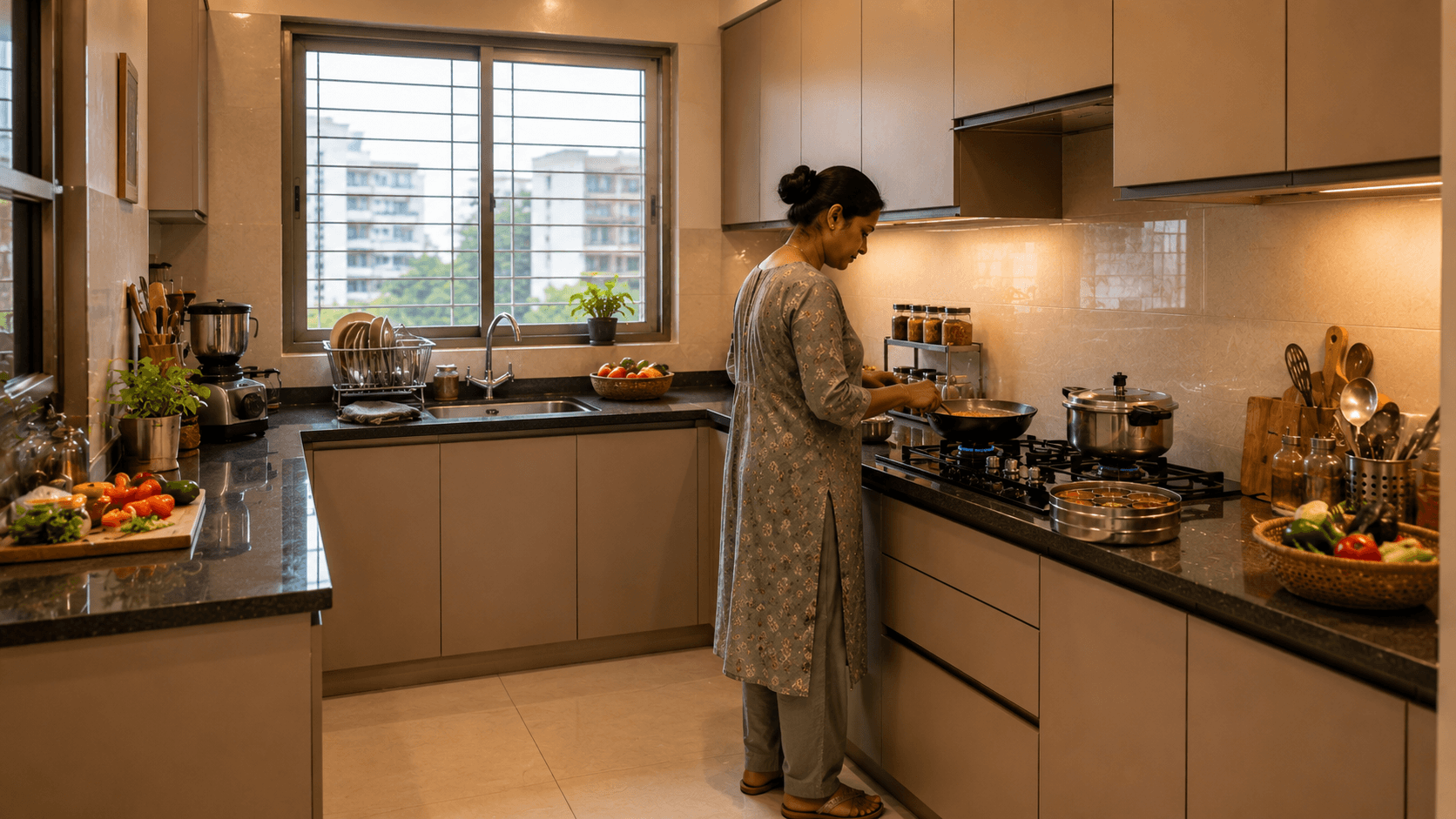
Most Indian homeowners spend two to four hours a day in the kitchen. That is a significant portion of your waking life — and most of it is spent standing, reaching, bending, and moving between the stove, sink, and counter in a rhythm that either flows naturally or fights you at every step.
Here is the uncomfortable truth: the majority of Indian modular kitchens are designed around what looks good in a brochure, not around the person who actually cooks in them. The result is counters at the wrong height, a sink tucked into an inconvenient corner, no clear prep space, and a layout that forces you to walk unnecessary steps dozens of times every meal.
Ergonomics is about fixing that. This guide walks you through what ergonomic kitchen design actually means in the context of Indian cooking, which layout works best for which situation, the one factor most people overlook completely, and the five mistakes that cause daily fatigue even in expensive kitchens.
What Kitchen Ergonomics Actually Means
Ergonomics in a kitchen context is not just about countertop height — though that matters enormously. It is about designing the entire space so that your body moves efficiently and comfortably through every cooking task, with minimal strain, wasted steps, and physical fatigue.
Think about what Indian cooking actually involves: kneading dough for rotis, stirring thick dals in heavy vessels, grating coconut or vegetables, washing large tawas and pressure cookers, and constantly moving between prep, cooking, and plating. These are physically demanding tasks that repeat daily. The wrong layout makes every one of them harder than it needs to be.
True kitchen ergonomics covers five dimensions:
- Reach and clearance — can you access everything without awkward stretching or crouching?
- Work surface height — does the counter height match your body so you are not hunching or over-reaching?
- Flow and movement — is the path between prep, cook, and clean zones short and obstacle-free?
- Zoning — does each function have a dedicated, appropriately sized area?
- Traffic logic — can multiple people move in the kitchen without constantly colliding?
The Work Triangle Is Evolving — Work Zones Are the New Standard
You have probably heard of the kitchen work triangle — the concept that the refrigerator, sink, and stove should form a triangle with each side between four and nine feet. It is a useful principle, and it holds up particularly well in smaller kitchens. The rule of thumb remains: the sum of all three sides should fall between 13 and 26 feet for comfortable movement.
But kitchen designers working in 2025 and 2026 are increasingly thinking beyond the triangle. The reason is simple: modern kitchens — and Indian kitchens especially — are not just three-appliance operations. They are multi-function spaces where you prep, cook, store dry goods, make chai, plate food, and often eat at the counter too.
The more useful framework is work zones — five dedicated areas that each serve a specific function:
- Storage zone — refrigerator, pantry unit, tall unit for dry goods, masala drawers
- Prep zone — your main cutting and vegetable chopping counter, ideally near the refrigerator with space on both sides
- Cooking zone — hob, chimney, and surrounding counter space for hot vessels
- Cleaning zone — sink, dish rack area, possibly a compact dishwasher
- Serving zone — a dedicated counter or peninsula where food gets plated or staged before the table
In Indian kitchens specifically, you often need a sixth zone: a wet masala or grinding station near the prep area, sized to accommodate a mixer-grinder and with an electrical point at counter height. Planning this from day one prevents the juggling act most Indian home cooks end up doing with the mixer on the floor or the far corner of the counter.
How Each Kitchen Layout Scores on Ergonomics
Not all kitchen layouts are equally ergonomic. Here is an honest comparison based on how each one handles flow, zoning, and movement:
L-Shaped Kitchen
The L-shaped kitchen is the most versatile ergonomic layout for Indian urban homes. It naturally creates a work triangle across the two walls and allows for a clear prep zone on one counter arm and cooking on the other. The corner junction can feel wasted if not handled with a magic corner unit or Le Mans carousel, but when planned well, it becomes excellent additional storage.
Best for: 2BHK and 3BHK apartments, homes where one to two people cook regularly, open or semi-open kitchen plans.
Parallel (Galley) Kitchen
Galley layouts are underrated. A well-planned parallel kitchen puts everything within an arm's reach on either side, making it arguably the most efficient layout for a single-cook household. The wet zone (sink, washing) goes on one counter, the dry zone (cooking, prep) on the other. Cross-contamination of water and oil — a real issue in Indian cooking — is minimised by design.
The critical ergonomic requirement: a minimum of 3.5 feet (106 cm) of clear walking space between the two counters. Tighter than that and the kitchen becomes physically difficult to navigate, especially if you are opening oven or dishwasher doors.
Best for: Compact city apartments, dedicated kitchen corridors, serious cooks who want everything at arm's reach.
U-Shaped Kitchen
The U-shaped kitchen offers the best ergonomics for households where heavy, multi-dish cooking is the norm. Three walls mean you can place each major zone on a separate counter, with minimal steps between them. It is the layout of choice for families who cook multiple courses for large gatherings.
The trade-off is that U-kitchens need adequate room to not feel enclosed. If your kitchen is narrower than 8 feet, a U-shape will feel cramped. Two corner junctions also need to be planned carefully to avoid dead storage zones.
Best for: Independent houses, large enclosed kitchens, households where two or more people cook together.
Island Kitchen
An island kitchen is ergonomically excellent when you have the space for it — and specifically when the island is used as a dedicated prep zone separate from cooking. This frees up the main counter for plating and service, creating a smooth one-way workflow. However, islands require a minimum of 4 feet of clearance on all sides to function ergonomically, which means they need large kitchen spaces.
Best for: Villas, independent floors, open-plan kitchens of 200 sq ft or more.
The Ergonomic Blind Spot: Counter Height
Standard Indian modular kitchen counters are installed at 34 to 36 inches (86 to 91 cm). This is meant to suit an average standing height of around 5'4" to 5'7". The problem? A significant number of Indian home cooks — particularly women — are shorter than this, and even small mismatches in counter height cause real physical strain.
Research on Indian kitchen ergonomics has found that when a counter exceeds a user's elbow height by even 6 to 10 cm, tasks like stirring, kneading, and grating cause pain in the shoulders, neck, and upper back. The reverse is equally problematic — a counter that is too low forces a forward stoop that strains the lower back.
The practical rule: the ideal counter height is 4 inches below your elbow when you are standing relaxed with arms at your sides. For most Indian women between 5'0" and 5'3", this puts the optimal counter at 31 to 33 inches — notably lower than the standard 34 to 36 inches sold as default.
A smarter solution, increasingly popular in well-designed kitchens, is a multi-level counter system: the main prep and cooking counter at the standard 34 inches, with a secondary lower platform at 30 to 32 inches for tasks like kneading dough and heavy chopping. This single change can dramatically reduce daily fatigue for the primary cook in the household.
The sink is also worth separate consideration. Because you lean forward slightly over a sink, the ideal sink counter is typically 2 to 3 inches higher than your prep counter — not the same height. Most kitchens ignore this and install everything at a uniform level.
The 5 Biggest Ergonomic Mistakes in Indian Kitchens
These are the errors that appear repeatedly — even in kitchens that look beautiful:
1. Not enough counter space beside the sink. The sink needs a minimum of 60 cm of clear counter on one side (for stacking dirty dishes) and 45 cm on the other (for draining). When a sink is wedged into a corner with no counter space beside it, every washing task becomes harder than it needs to be.
2. No dedicated prep zone. Many Indian kitchens have beautiful storage and cooking setups but no clear prep area — just a narrow strip beside the stove that doubles as everything. A proper prep zone should have at least 60 to 90 cm of unobstructed counter, be close to the refrigerator, and ideally have a power point at counter level for the mixer-grinder.
3. Overhead cabinets too high or too deep. Standard overhead cabinet installation places the bottom of upper cabinets at 54 inches from the floor — out of reach for many Indian home cooks. The lower edge of overhead cabinets should sit no higher than 18 inches above the countertop. For users under 5'3", bring this to 15 to 16 inches above the counter.
4. Ignoring clearance between counters. In parallel and U-shaped kitchens, inadequate clearance is a common issue — especially when the original plan looked adequate but a built-in appliance or a tall unit reduced the walkable space. The minimum functional clearance is 3.5 feet between facing counters. For two-cook households, 4 feet is more comfortable.
5. Mixing traffic flow with work flow. If the main entry or exit to the kitchen passes through the cooking and prep zone, the kitchen will constantly feel chaotic. Good ergonomic planning keeps the work path (refrigerator → prep → stove → sink) separate from the traffic path (entry and exit). This is a layout-level decision that cannot be retrofitted easily — it must be part of the original design.
Designing for Multi-Cook and Multi-Generation Households
Many Indian households are multi-generational, with parents or in-laws who also cook. This changes the ergonomic brief entirely. A kitchen optimised for one person's height and reach may be genuinely difficult for another to use comfortably.
For households where elderly family members cook regularly, consider: pull-out shelves in lower cabinets instead of fixed shelves (they eliminate deep bending), lever-style tap handles at the sink rather than knobs, and a higher toe-kick that reduces the need to crouch. Anti-fatigue floor mats at the cooking and sink position also make a meaningful difference for users who stand for extended periods.
For two-cook households, the key ergonomic principle is zoning that allows two people to operate simultaneously without blocking each other. Typically, this means one person controls the cooking zone while the other works the prep and washing zones — layouts that support this parallel activity without crossing paths are the U-shaped kitchen and the island kitchen.
What This Means When You Are Planning Your Kitchen
Ergonomic kitchen design is not expensive to implement — but it requires the planning decisions to be made correctly before manufacture starts, not after. Counter height is set in stone once the cabinets are built. Zone placement depends on where your plumbing points and gas lines go. Overhead cabinet height is fixed once the drilling is done.
This is why the conversation about ergonomics needs to happen at the design stage — not as an afterthought. A good kitchen designer will measure your elbow height, ask about your household's cooking habits, map out each zone before placing a single cabinet, and flag potential flow problems before they become permanent fixtures.
If you are still deciding which layout suits your space, the ARITSAN Kitchen Planner lets you check whether an L-shaped, parallel, U-shaped, or island layout actually fits your wall lengths and clearances before you commit. For a detailed walkthrough of what your kitchen could look like, a free consultation with an ARITSAN designer covers measurements, zones, and ergonomic planning specific to your home.
Also worth reading: smart storage ideas that work alongside an ergonomic layout, and our guide to maximising compact kitchen spaces for urban apartments.
Frequently Asked Questions
What is the ideal countertop height for an Indian kitchen?
The standard Indian kitchen counter is installed at 34 to 36 inches. However, the ideal height is 4 inches below your elbow when standing. For users under 5'3", this typically means a counter between 31 and 33 inches is more ergonomic. A multi-level counter system — with a lower secondary platform for kneading and heavy chopping — is the most practical solution for households where different family members cook.
Which kitchen layout is most ergonomic?
There is no single answer — it depends on your kitchen size and household. For compact apartments, a well-planned parallel kitchen is extremely efficient. For medium-sized kitchens, the L-shape offers the best balance of ergonomics and openness. For large kitchens with heavy cooking demands, the U-shape is the most ergonomically complete layout. Islands work best in open-plan spaces where they act as a dedicated prep zone.
What is the work triangle rule for kitchens?
The kitchen work triangle connects the sink, stove, and refrigerator. Each side of the triangle should be between 4 and 9 feet, with the total of all three sides falling between 13 and 26 feet. While still useful as a starting point, modern kitchen planning increasingly focuses on work zones rather than just the three-point triangle, especially in multi-function or multi-cook kitchens.
How much counter space is needed beside the sink?
A sink should have at least 60 cm (roughly 24 inches) of clear counter on one side and 45 cm (18 inches) on the other. This allows space for stacking dishes on one side and draining or drying on the other. Sinks placed in corners with no counter space on either side are one of the most common ergonomic planning mistakes in Indian kitchens.
What clearance is needed between counters in a parallel kitchen?
A minimum of 3.5 feet (106 cm) between facing counters is required for comfortable navigation. For households where two people cook simultaneously, 4 feet of clearance is recommended. Less than 3 feet makes the kitchen difficult to use practically, especially when appliance doors are open.